
Seamless or sectional gutters, and how to choose
Every joint in a gutter is a place water can find its way out. Seamless runs formed on site cut down on those joints, while sectional gutters trade more seams for easy repairs and do-it-yourself installation.
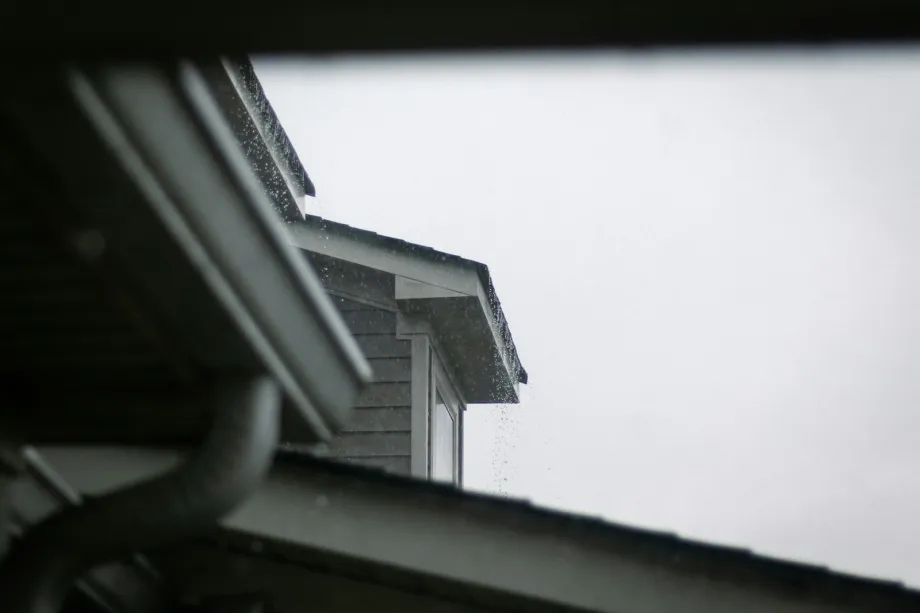
Two ways to build the same gutter
Both kinds of gutter do the same job. The difference is how the long straight stretches are made.
Sectional gutters come in factory lengths. On a long wall, several pieces are joined with connectors or overlapping slip joints, and each joint is sealed. Seamless gutters are formed at the house. The installer feeds a flat coil of metal, most often painted aluminum (sometimes copper or steel), through a roll-forming machine that shapes it into a K-style or half-round profile. Each run is cut to the measured length of that wall, so there is no joint between the corners.
Where the leaks start
Joints are the usual first leak on any gutter. Sealant ages, metal moves, and a small gap is all water needs.
The climate along the lake is hard on joints. Snow melts on a sunny afternoon, runs into the gutter, and refreezes overnight. Water that has worked into a joint expands when it freezes. Add the normal expansion and contraction of metal through big temperature swings, and sealant gets pushed and pulled until it lets go. Wet leaf drop in fall makes it worse by holding standing water against the joints.
Fewer joints means fewer chances for that to happen. A seamless system still has corners, end caps and outlets, and those can leak just like any other joint. But a long wall that would need several connectors in a sectional system has none.
Sectional gutters as a do-it-yourself project
Sectional gutters are what home centers stock, usually in vinyl or prepainted aluminum, along with matching corners, end caps, outlets and connectors. The short lengths fit in a pickup or on a roof rack and are easy to handle on a ladder.
Installation takes basic tools: a measuring tape, a level or string line, snips or a fine-tooth saw, a drill and a caulking gun. Hangers go on the fascia first, set to the slope you want, then the pieces are fitted together and every joint is sealed according to the product instructions. On a garage, shed or simple one-story house, that is a manageable weekend for someone comfortable on a ladder.
The trade-off is the joints themselves. Each one needs careful sealing at install and attention over the years.
Repairs on each type
When a branch comes down on a sectional gutter, the fix can be modest. Unfasten the damaged piece, disconnect it from its neighbors, slide in a matching length and reseal the joints.
A seamless run is harder to repair in part. Small dents can sometimes be eased back, and small holes can be sealed or patched from the inside. Real damage across a long length usually means replacing the whole run between corners, which brings the forming machine back. Cutting out a section and splicing in a new piece is possible, but it adds exactly the kind of joint the system was meant to avoid.
Cleaning differences
Inside a sectional gutter, connectors and overlaps leave small ridges on the floor of the trough. Twigs, needles and leaf stems catch on them and start small dams. Seamless runs have a smooth floor between corners, so debris and water move toward the outlet more freely. Both still need regular cleaning.
Looks and matching the house
From the street, a seamless gutter reads as one clean line along the eave. Sectional gutters show a joint every few feet, which some people do not mind and others notice right away.
Coil stock for seamless gutters comes in a wide range of factory finishes, which makes it easier to match or contrast with fascia, trim and soffits. Off-the-shelf sectional gutters are usually limited to a handful of standard colors. Vinyl can fade and grow brittle with years of sun and cold, so painted metal tends to keep its looks longer in this climate.
Fascia matters for both. The gutter is only as straight and secure as the board behind it. Soft or rotted fascia should be repaired before any new gutter goes up.
Pitch and support
Either type needs a slight fall toward the downspouts so water does not sit in the trough. Long seamless runs hold a steady slope well. Sectional gutters can develop small dips at joints if hangers are too far apart, and those dips hold water. Hanger spacing for snow country is something to settle with the installer or the product instructions.
Which one fits your house
Sectional gutters make sense for small, simple rooflines, outbuildings, a tight budget or a homeowner who wants to do the work. Seamless gutters suit long eaves, houses where leaks at joints have been a recurring problem, and owners who want a clean line and do not plan to install it themselves.
Safety and who does the work
Installing any gutter means hours on a ladder with tools and long, awkward pieces in hand. Firm footing, a stabilizer that keeps the ladder off the eave, three points of contact and a helper on the ground are the basics. Watch for the electric service line near the roof edge.
Seamless gutters are a professional job by nature. The forming equipment is specialized, and a long run of thin metal flexes and kinks easily, so it takes a coordinated crew to lift and hang it without damage. That same crew should be setting the slope and sealing the corners and outlets properly.
Frequently asked questions
Do seamless gutters have any joints at all?
Yes. Inside and outside corners are still joined, and so are end caps and downspout outlets. What disappears are the joints along each straight run.
Can I install seamless gutters myself?
Not really. They are formed from a coil of metal on a machine the installer brings to the house, and long runs need several people to lift without kinking. Sectional gutters are the do-it-yourself option.
Why do joints leak more in a cold climate?
Water that sits in a joint can freeze and expand, and metal gutters move as temperatures swing. Over several winters that movement works sealant loose and opens small gaps.
Which type is easier to repair?
Sectional gutters, usually. A damaged piece can be unfastened and replaced. A dented seamless run is patched or replaced as a whole straight length.
Related guides
Choosing gutter materials, profiles and sizes
The right gutter for a house near Lake Erie has to carry summer downpours and survive winters of freeze-thaw and ice. Material, profile, size and the way it hangs all pla…

Finding and fixing gutter leaks
A leaking gutter rarely announces itself at the leak. The clues show up below it, on siding, trim and the ground, and most of them can be read without a ladder.

Cleaning gutters yourself without getting hurt
Most gutter injuries come from the ladder, not the gutter. Set it up right, keep your weight between the rails and know which jobs belong to someone with better equipment…